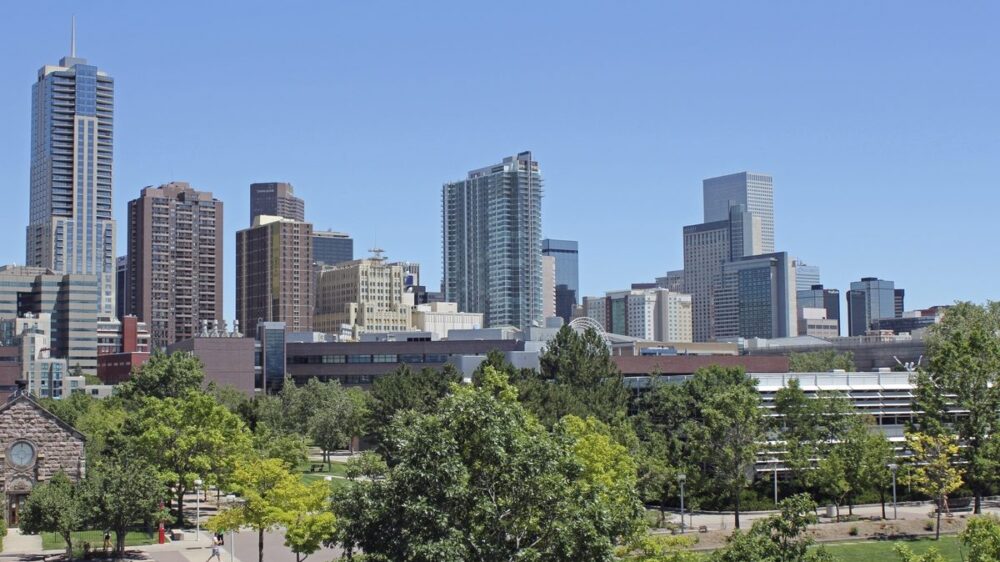
Green infrastructure is an urban development practice used to help mitigate some of the climatic challenges associated with living in densely populated areas like cities. These practices are rooted in mimicking the processes occuring in ecosystems and integrating city development with nature. Green infrastructure is also designed to provide additional ecosystem services/benefits beyond just aesthetics but have direct ecological and human benefits. Think, mini habitat parks, pollinator gardens, green roofs and so much more! With direct impacts on water quality – green infrastructure is the missing component when addressing issues with stormwater systems.
It’s no secret that municipal waterways and its surrounding communities feel the adverse effects of our stormwater systems and water quality. Our current stormwater system all eventually outfalls to the South Platte River (The Office of Green Infrastructure). The design of this system helps us mitigate flooding during infrequent heavy precipitation events, however the majority of point and nonpoint source pollutants will accumulate in our South Platte River (City and County of Denver). This results in a wave of cascading ecological impacts on our South Platte River, and the city itself. When it comes to approaching stormwater management, we are excited that DOTI (Denver Department of Transportation & Infrastructure) alongside other governmental bodies seems to also recognize how important Green Infrastructure is in developing a stronger and safer Denver for all.
Stormwater systems are massively important to have in cities – due to how many impervious surfaces there are, it prevents water from being absorbed into natural systems like soils, permeable rocks, or into waterways (The Office of Green Infrastructure). When precipitation falls onto dense areas it must find the nearest drainage point using gravity. This entails water collecting runoff pollutants, litter, and nutrient pollutants before entering the larger system. “Managing stormwater runoff has, to date, been the primary driving principle behind the increased use of green infrastructure in urban environments (The Office of Green Infrastructure). By utilizing natural solutions, green infrastructure is a natural climate solution that can improve water quality, reduce urban heat, increase biodiversity and habitat integrity – and so much more (City and County of Denver)!
But what does Green Infrastructure mean for a Denver that is still growing? A Denver that needs to balance the priorities of making safe spaces for the people who live here, and ensuring a safe environmental future for all? DOTI (Denver Department of Transportation & Infrastructure) and other government offices aim to integrate green infrastructure practices into stormwater systems, whilst taking opportunities in future development (The Office of Green Infrastructure). For future design and development, Denver plans to follow a few guiding principles for our storm drainage systems revolving around green infrastructure.
One key principle is reducing the amount of impervious surfaces. This is the leading issue when it comes to pollutants entering our storm drain system and our local waterways. The most practical solution to implement right now is to minimize directly connected impervious areas (MDCIA). This is made possible by adding vegetated areas like grass buffers, bioswales, rain gardens, permeable pavements and more (The Office of Green Infrastructure). These systems, often referred to as bioretention facilities, utilizes the natural filtration of soil in order to offset the amount of runoff pollution entering the stormwater system, increasing the water quality of fallen precipitation and reducing peak flows of drainage (Monteiro et al., 2020). By fragmenting impervious surfaces with different bioretention green infrastructure, precipitation that falls onto our city can be more likely to fall onto a soil system (like rain gardens) (City and County of Denver).
Green infrastructure, like rain gardens or tree trenches, are also opportunities to support native plant populations and urban tree canopy (The Office of Green Infrastructure). “Modeling efforts by the Office of Green Infrastructure have shown an approximate 2 degree F decrease in land surface temperatures for every 10% increase in canopy coverage” (The Office of Green Infrastructure). As future infrastructure develops our stormwater systems, it is important to note the drastic impact that tree canopy has on reducing surface heat and runoff. (Monteiro et al., 2020).
Another key consideration for designing green infrastructure is the shape, size, and filtration structural components of storm drain inlets. Sizing, filtration components, and blocks are all important components to designing an inlet that mitigates against climate change (City and County of Denver). Many inlets can block larger pollutants and litter, but will accumulate at the inlet basin, requiring routine cleaning (The Office of Green Infrastructure). These blocks can be further aid in runoff filtration through deliberate implementation of secondary filtration systems, like the Gutter Bins from Frog Creek Partners (The Greenway Foundation) that was trialed in 2019. These systems can help collect large and small pollutants, but requires diligent maintenance to be effective (The Greenway Foundation).
Overall, green infrastructure is a promising avenue for mitigating issues with our current stormwater systems. By utilizing nature in our urban development, we can take some of the pressure off of our river and riparian ecosystems, allowing for our South Platte River to be a more dynamic, productive and healthy ecosystem for all! Plus, who doesn’t want a city with more green space in it? I know we sure do! Vist https://denvergov.org/Government/Agencies-Departments-Offices/Agencies-Departments-Offices-Directory/Department-of-Transportation-and-Infrastructure/Programs-Services for more information on how green infrastruct
Works Cited
City and County of Denver. “City and County of Denver Storm Drainage Master Plan.” Denver Gov, 2 March 2023, https://www.denvergov.org/files/assets/public/v/2/doti/documents/plans/2019_storm_drainage_master_plan.pdf. Accessed 14 December 2023.
The Greenway Foundation. “Gutter Bins.” The Greenway Foundation, https://thegreenwayfoundation.org/stewardship/gutter-bins/. Accessed 5 January 2024.
The Office of Green Infrastructure. “Denver Green Continuum – Street Guidelines.” DOTI, 2 March 2023, https://denvergov.org/files/assets/public/v/2/doti/documents/standards/doties-018.0-green-continuum-streets-guidelines.pdf. Accessed 14 December 2023.Monteiro, R.; Ferreira, J.C.; Antunes, P. Green Infrastructure Planning Principles: An Integrated Literature Review. Land2020, 9, 525. https://doi.org/10.3390/land9120525.

 GLC: CSU Environmental Learning center